The Denim Files: What Happens When Denim Becomes a Hat?

Denim is one of those fabrics we think we already know.
Most of us first encountered it as a pair of jeans. We know how dark denim slowly fades, how stiff fabric softens, and how a favorite pair eventually begins to feel less like something we bought and more like something that belongs to us.
Then denim moves from our legs to our heads, and the cloth takes on a different personality.
In a baseball cap, denim feels completely natural. In an engineer or worker's cap, it returns to its workwear roots. A denim newsboy feels more relaxed than one made from wool. Shape it into a pork pie, and the result is something less expected: structured and distinctive, but still casual enough to wear with jeans and a T-shirt.
That is what first drew me into this subject.
The fabric may be familiar, but every style of hat asks it to do something different.
Denim Changes Shape
A cap crown has to curve comfortably around the head. Several pieces of fabric may come together within a very small area. The brim must bend, hold its shape or, in some designs, turn upward without looking forced. Inside, the denim must work with the sweatband, seams, lining and whatever material gives the brim its structure.
A beautiful piece of denim does not automatically make a good hat.
The pattern, sewing, fit and interior construction still matter.
Traditional blue denim is generally a warp-faced cotton twill. In plain English, the yarns running lengthwise through the cloth are commonly dyed with indigo, while the yarns running across it are left white or natural.
That is what gives familiar blue denim its darker face, lighter reverse and diagonal lines.
Those diagonal lines are not printed on the fabric. They are created by the way the yarns cross during weaving.
Denim is not one single, uniform material. Change the yarn, weave, weight, dyeing method, washing or finishing, and the cloth can look and feel very different.
What Fabric Weight Tells Us
Fabric weight is one of the first numbers we encounter.
When a maker describes a hat as being made from 12-, 14- or 15-ounce denim, that number normally refers to the weight of one square yard of fabric. It does not mean the finished hat itself weighs 14 ounces.
A heavier denim will often give a cap more body and structure, but weight never tells the entire story.
One 14-ounce fabric may feel firm and stubborn. Another fabric of the same weight may feel surprisingly comfortable after it has been washed and softened. Yarn size, yarn twist, the tightness of the weave and the finishing process all help determine how the cloth behaves.
The hat pattern matters just as much.
A six-panel baseball cap divides the crown into smaller sections that help relatively firm denim follow the shape of the head. A fuller newsboy allows the material to fold and drape. A close-fitting engineer or worker's cap uses denim's structure in another way. A pork pie asks the cloth to form a defined crown and brim without becoming uncomfortable or looking like a novelty.
That is why two hats made from "14-ounce denim" may not feel remotely alike.
Raw, Washed and Selvedge
Then we come to the language used to describe denim: raw, washed, selvedge, slub, nep and broken twill.
Those terms can tell us something useful about the fabric. None of them, by itself, guarantees a well-made hat.
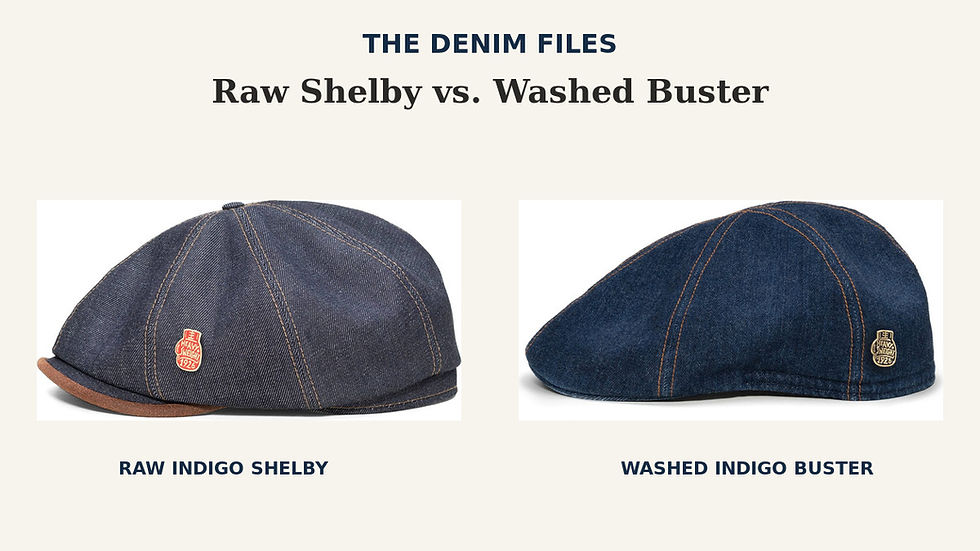
Raw denim has not gone through the washing and finishing commonly used to soften denim or give it an already-worn appearance. It will usually begin darker and firmer, leaving more of the visible change to happen through wear and washing.
Washed denim has already begun that process. Washing can remove some of the compounds used during weaving, soften the fabric and reduce some of its original stiffness.
Raw and selvedge do not mean the same thing.
Selvedge, also spelled selvage, is the woven edge running along the sides of the original cloth. A maker may display that edge as a design detail, hide it inside the hat or use it as part of the sweatband.
Selvedge denim can be raw, rinsed or thoroughly washed. A visible strip of selvedge may be interesting, but it does not prove that the hat will fit properly, feel comfortable or be well sewn.
Four Makers, Four Approaches
Several American makers show how differently the same general fabric can be used.
Raleigh Denim Workshop has produced a limited-run six-panel cap from deadstock White Oak selvedge denim woven in Greensboro, North Carolina. A narrow strip of the selvedge identification appears on one of the front panels. The cap was designed in North Carolina and made in the United States.
Monsivais & Co. takes denim in a different direction. Its Workers Cap is inspired by engineer and workman caps of the 1930s and '40s. One current version is made in Los Angeles from 12-ounce deadstock White Oak Cone Mills selvedge denim, with taped interior seams and a sweatband made from the selvedge edge.
WiesMade offers another American interpretation: a straightforward ball cap made in California from 14-ounce broken-twill denim woven by Mount Vernon Mills. In broken twill, the diagonal weave changes direction rather than continuing in one uninterrupted line across the cloth.
In Japan, D & H applies denim to a much wider assortment of shapes, including baseball caps, work-inspired caps, brimmed hats and pork pies.
The 14-ounce gray slab-denim pork pie I ordered is washed after it is made. It should therefore arrive more ready to wear than a completely unwashed raw-denim hat.
Other terms describe the texture of the yarn itself.
A slub is simply a thicker section in a yarn. When those variations are woven into denim, they can create an uneven or streaked surface.
Nep appears as small knots, flecks or raised fibers in the cloth. Both slub and nep can give denim more visible character, especially in a hat, where the fabric is sitting close to eye level.
But an interesting fabric cannot rescue a crown that sits poorly, an uncomfortable sweatband or a brim that never seems to look right.
What The Denim Files Will Test
That will be an important principle throughout The Denim Files.
We will pay attention to where the fabric was woven, what it weighs and what gives it its texture. But we will not be blinded by impressive-sounding terminology.
We will look at how the crown sits, whether the sizing is accurate, how the brim works with the design, how the interior is finished, and what happens after the hat has been worn in heat, handled repeatedly and exposed to ordinary life.
Most importantly, we will wear them.
A denim hat cannot be fully understood from a product description. It needs time on the head. It needs sunlight, handling, sweat and ordinary use.
The mills and technical terms matter because they help us understand the hat.
The hat itself remains the point.
Jeans may be where most of us first encountered denim.
They are not where its story ends.
Sources and Further Reading
The Denim Manual, Fashionary.
American Denim: The Supposed Final Days and Resurgence of a Manufacturing Icon, by Matt Sharkey.
Personal photograph by Jerry Gault.