Banjo Paterson: Between the City and the Bush

Under the Australian Brim, Part Two
The name sounded as though it belonged to a horseman.
In a way, it did.
During the 1880s, poems signed “The Banjo” began appearing in The Bulletin. Readers encountered drovers, racehorses, station hands, and riders moving through country far beyond Sydney’s offices and crowded streets.
The writer behind the name was Andrew Barton Paterson, a young Sydney solicitor. He had borrowed his pen name from a racehorse owned by his family.
That is the first surprise in Paterson’s story. One of Australia’s best-known bush poets spent much of his early adult life practicing law in the city.
A Country Childhood, a City Career
He was not, however, imagining the bush from nothing.
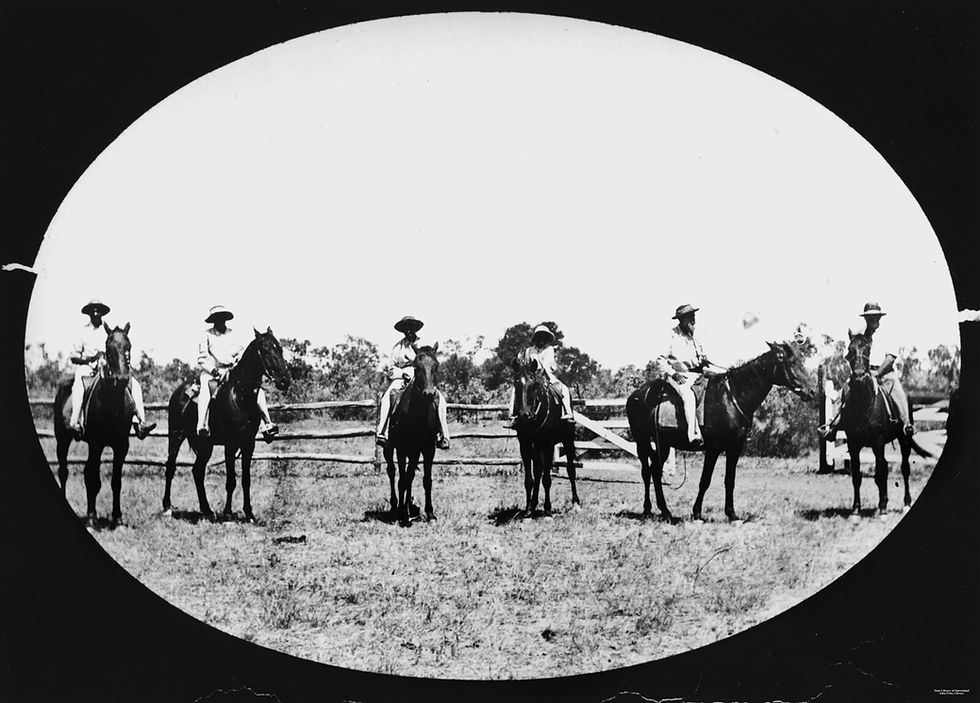
Paterson was born at Narrambla, near Orange, New South Wales, in 1864. When he was seven, his family moved to Illalong in the Yass district. Their home stood near the main route between Sydney and Melbourne, where bullock teams, Cobb & Co. coaches, drovers moving livestock, and gold escorts became familiar sights.
At local race meetings and polo matches, Paterson watched some of the best riders from the Murrumbidgee and Snowy Mountains country. Horses stayed with him for the rest of his life. He later rode with the Sydney Hunt Club, played polo, and raced as an amateur at Randwick and Rosehill.
At ten, Paterson was sent to Sydney Grammar School. He later trained in law and was admitted as a solicitor in 1886.
The city and the country were never entirely separate in his life. He worked among contracts and legal papers while writing about riders, horses, and open land. That movement between two worlds would become one of the defining features of his work.
You can see it clearly in “Clancy of the Overflow.” The poem’s city-bound narrator imagines the freedom of a drover riding across the western plains. The bush becomes an escape from office walls, dusty streets, and the sameness of clerical work.
Paterson understood both sides of that contrast.
The Man from Snowy River
His breakthrough came with “The Man from Snowy River,” published in The Bulletin in April 1890. The poem tells of a slight, underestimated mountain rider who joins a group pursuing a valuable colt into dangerously steep country. When the celebrated horsemen pull back, the rider from Snowy River continues.
Readers embraced the story.
In October 1895, Angus & Robertson published The Man from Snowy River and Other Verses. According to the Australian Dictionary of Biography, the first edition sold out during its first week, and 7,000 copies were sold within a few months. Paterson’s identity as “The Banjo” was revealed, turning the Sydney solicitor into a national literary figure.
The poem offered more than a thrilling ride.
Its hero was not the richest man, the most imposing figure, or the owner of the finest horse. He was the person who understood the country and possessed the skill to move through it.
That was a powerful story for an Australia approaching Federation. Paterson’s bushman appeared resourceful, independent, and quietly capable.
The Bush Legend and Its Limits
But Paterson’s bush was not the whole of Australia.
His poems helped popularize a romantic national image built around riders, drovers, open country, and life beyond the cities. The State Library of New South Wales describes that image as powerful but selective: masculine, independent, and turned toward an idealized bush heartland. It left much of Australian life outside the frame.
Paterson was not blind to hardship. His writing included drought, dust, struggling properties, and dying livestock. Yet his instinct was often to find energy, humor, and movement where Henry Lawson found loneliness, exhaustion, and disappointment.
The two writers even argued the question in verse through the pages of The Bulletin. Their exchange later became known as the Bulletin Debate.
It should not be mistaken for a bitter feud. The Australian Dictionary of Biography calls it a friendly rhyming battle and notes that Paterson helped Lawson prepare publishing contracts. They disagreed over the bush, but they were not enemies.
Waltzing Matilda
Paterson’s fame grew again through a song written in Queensland.
While visiting Dagworth Station near Winton in 1895, he wrote the words that became “Waltzing Matilda.” Christina Macpherson played a melody adapted from a Scottish song, and Paterson fitted his words to it. She later wrote down the music and verses in the manuscript now held by the National Library of Australia.
The song sounds cheerful, but its story is not. A swagman takes a sheep, is confronted by the squatter and police, and drowns himself rather than surrender.
Its relationship to the labor unrest and violence surrounding the 1894 Queensland shearers’ strike remains debated. Paterson never left one final explanation that settled the question.
That uncertainty is worth preserving. Familiar songs often carry more history than their listeners realize.
War Correspondent and Horseman
Paterson’s own life also reached far beyond poetry.
He traveled to South Africa in 1899 as a war correspondent for the Sydney Morning Herald and The Age. His reporting earned wider recognition, including work for Reuters. During the First World War, he drove ambulances in France and later served with the Australian Remount Unit in the Middle East, eventually holding the rank of major.
The poet who wrote so confidently about horses had practical experience behind the words.
The Hat Between Two Worlds

Akubra introduced the Banjo Paterson hat in 1995.
The company describes it as a safari-style fedora designed to move between outdoor use and more formal settings. It has a 70-millimetre brim, a pinched teardrop crown, satin lining, a leather sweatband, and a barramundi-leather outer band.
That makes the name unusually appropriate.
The Cattleman looks ready for long days in exposed country. The Stylemaster belongs easily in town. The Banjo Paterson sits somewhere between them.
So did the man.
Paterson was a country child and a Sydney solicitor, a horseman and a newspaper editor, a popular entertainer and a witness to war. He wrote about the bush from knowledge, affection, and imagination, but also from the distance of someone who understood what city readers wanted the bush to represent.
My own Banjo Paterson is in Heritage Fawn. I have worn it while writing, working around the house, and heading outdoors with a camera. It does not demand a costume or a grand expedition. It fits into ordinary life.
That may be another reason the name works.
Paterson’s poems made distant riders and open country feel close to readers sitting in cities. The hat bearing his name carries a little of that same movement. It can go outdoors without looking theatrical and return to town without appearing misplaced.
The bush Paterson wrote about was partly observed and partly imagined.
Either way, it became one of the ways Australia learned to see itself.
And beneath that brighter vision waited another writer with a harder story to tell.
Next: Henry Lawson and the human truth beneath the bush legend.
Sources
Australian Dictionary of Biography, Clement Semmler, “Andrew Barton (Banjo) Paterson.” Biography covering Paterson’s childhood, legal career, horsemanship, pen name, literary success, relationship with Henry Lawson, journalism, and military service.
National Library of Australia, “A National Identity.” Background on the creation of “Waltzing Matilda,” Christina Macpherson’s contribution, the surviving manuscript, and the debated connection to the 1894 shearers’ strike.
Australian War Memorial, “Fifty Australians: Banjo Paterson.” Paterson’s work as a war correspondent, ambulance driver, and officer in the Australian Remount service.
State Library of New South Wales, “Literary Giants: Revealing the Angus & Robertson Collection.” Publication history of The Man from Snowy River and Other Verses and its place in Australian publishing.
Akubra, “Banjo Paterson, Heritage Fawn.” Official product description, dimensions, and construction details.
Akubra, “The History of Akubra.” Company chronology dating the introduction of the Banjo Paterson model to 1995.
Further Reading and Additional Resources
USA Akubra dealer: David Morgan LLC.