More Than a Bush Hat: The Akubra Story

Under the Australian Brim, Part One
In November 2023, the workers at Akubra’s factory in Kempsey, New South Wales, were called together for an announcement.
The company had been sold.
For more than a century, Akubra had been owned and guided by the Keir family. In Kempsey, where the factory had operated since 1974, it was more than a familiar Australian name. It was a major regional workplace, filled with people who had spent years, and sometimes decades, learning the craft.
Among those listening that day was retired employee Terrence Hunt. He had spent 53 years with Akubra. He had watched machinery change, fashions come and go, and members of the Keir family take their turns guiding the company.
Now another chapter was beginning.
Akubra’s new owners promised that the hats would continue to be made in Australia. The work in Kempsey would continue as well: fur being shaped by steam and pressure, felt moving from one set of hands to another, and unfinished hat bodies slowly becoming something recognizable.
It was a moment of change, but also one of continuity. That seems an appropriate place to begin the Akubra story.

From Hobart to a National Name
The company’s history reaches back to 1876, when Benjamin Dunkerley established the Kensington Hat Mills near Hobart, Tasmania. Dunkerley was not simply selling hats. He was involved in the difficult work of preparing fur and turning it into felt.
He later moved the business to Sydney. In 1904, an English hatmaker named Stephen Keir joined him. Keir later married Dunkerley’s daughter Ada, joining the two families as well as the business.
The name Akubra was registered as a trademark on August 7, 1912.
The origin of the word is less certain.
For years, it was often said to come from an Aboriginal word for a head covering. Akubra now describes the origin as unresolved, while the Australian National Dictionary Centre lists it as unknown.
That uncertainty is worth preserving. A good story does not become stronger simply because its gaps have been filled with confident guesses.
More Than One Australia
What can be documented is the way Akubra grew into Australian life.
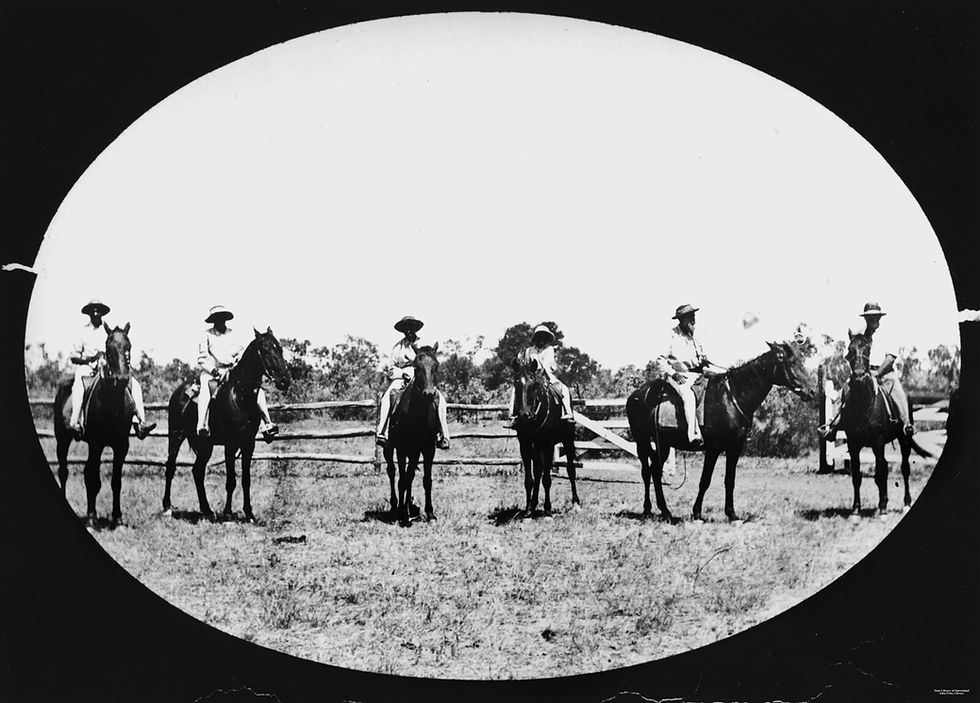
Today, the name is closely tied to broad-brimmed bush hats. It brings to mind cattle stations, dusty roads, horses, sheep, and people working beneath a hard sun. Those associations are real, but they are only part of the company’s history.
Australian newspaper advertisements from the 1920s and 1930s show Akubra hats being sold as fashionable town wear. Customers were offered new shapes, seasonal colors, and hats for sport, business, shows, and the races. Akubra belonged on city streets and railway platforms, as well as on farms and cattle stations.
You can still see that wider history in Akubra’s catalog today. The Cattleman and the Stylemaster come from the same factory, but they do not feel as though they were made for the same life.
The Cattleman belongs outdoors, under a hard sun and through long working days. The Stylemaster looks just as comfortable on a city street, worn with a jacket.
The Military Slouch Hat
Akubra also became closely associated with the Australian military slouch hat, although the distinction matters: the company did not invent it.
Felt slouch hats were already being worn by Australian colonial forces during the nineteenth century. In 1885, a khaki felt hat became part of the uniform of the Victorian Mounted Rifles. Other colonial forces adopted similar hats, and after the creation of a single Australian army, the slouch hat became part of its uniform.
Its turned-up brim, puggaree, chinstrap, and badge eventually became some of the most recognizable elements of the Australian soldier’s appearance.
Akubra became one of the manufacturers that supplied them.
According to the company’s history, by 1943 approximately 80 percent of Akubra’s production was devoted to the armed forces. The Australian War Memorial also holds surviving examples, including a 1956 fur-felt slouch hat marked with both the Dunkerley and Akubra names.
That surviving hat makes the history tangible. It takes the story beyond advertisements and company memory.
Someone made it. Someone was issued it. Someone wore it as part of a uniform.
Made by Hand in Kempsey
Every Akubra still being used has to pass a simpler test. However strongly it may be associated with national identity, it still has to do the ordinary work of a hat.
It must shade the eyes. It must stay on in the wind. It must remain wearable through heat, dust, rain, travel, and long hours outside.
The material helps.
Akubra hats are made from rabbit-fur felt. During production, prepared fibers are exposed to moisture, heat, pressure, and repeated handling. The fibers shrink and bind together, forming a dense material that can be shaped without being woven.
The first felt body looks little like a finished hat. It begins as a large cone, nearly three times the size of the completed hat. It is gradually condensed, dyed, blocked, sanded, polished, shaped, and fitted with the details required by the model: perhaps a leather sweatband, lining, ventilation eyelets, ribbon, brim binding, or braided band.
Akubra describes the full process as involving 162 steps.
The number is impressive, but it is not the most interesting part.
These hats do not emerge fully formed from a single machine. Akubra says a hat passes through at least 15 pairs of skilled hands. Machinery helps form and finish the felt, but much of the final result still depends upon human judgement.
Steam softens it. Blocks establish the shape. Hands adjust, inspect, smooth, trim, and finish it.
That work continued after Akubra moved from Sydney to Kempsey in 1974. It continued through changing fashions and changing ideas about what an Australian hat should look like. It continued when the Keir family sold the company to Tattarang in 2023.
This helps explain why Akubra is difficult to reduce to a single image.
For one person, it is a work hat bleached by sun and marked by sweat. For another, it is part of a military uniform. It may be worn to the races, carried on a journey, inherited from a parent, or kept by the door because it is the most useful hat in the house.
It can also be a way into Australian history.
Four Hats, Four Stories
The four Akubras at the center of this series each lead somewhere different.
The Cattleman takes us toward rural work, heat, livestock, and the practical demands of life outdoors.
The Stylemaster leads back into town, where Akubra’s urban history is easier to see.
The Banjo Paterson carries the romance, movement, and poetry of the Australian bush tradition.
The Lawson tells a harder story: drought, isolation, labor, and the lives of ordinary people who did not always find freedom beneath the wide Australian sky.
The hats are where we begin.
The people who wore them, and the country that shaped them, are the real story.
Next, we turn to the hat named for one of Australia’s best-known poets: the Banjo Paterson.
Sources
Akubra, “The History of Akubra.” Company chronology covering Benjamin Dunkerley, Stephen Keir, the 1912 trademark, wartime production, the move to Kempsey, and the 2023 sale.
Akubra, “Handcrafting an Akubra.” Company explanation of rabbit-fur preparation, felting, blocking, sanding, shaping, finishing, and the 162-step manufacturing process.
Australian Broadcasting Corporation, “Mining Magnates Andrew and Nicola Forrest Buy Australian Hat Maker Akubra from Keir Family,” November 19, 2023. Includes the Kempsey announcement and Terrence Hunt’s 53 years with the company.
Australian National Dictionary Centre, Australian National University, entry for “akubra,” including its recorded meaning and the conclusion that the word’s origin is unknown.
Australian War Memorial, “The Slouch Hat: Trademark of the Australian Army.” History of the slouch hat’s adoption by Australian colonial and Commonwealth forces.
Australian War Memorial, collection record for the 1956 slouch hat associated with Colonel V. G. Bulteau, stamped “Dunkerley Ltd ‘Akubra.’”
National Library of Australia, Trove, newspaper advertisements from the 1920s and 1930s showing Akubra hats marketed for fashion, sport, business, shows, and race meetings.
Tattarang, “Looking Forward, Looking Back: Akubra Celebrates 50 Years in Kempsey,” October 19, 2024.
Further Reading and Additional Resources
USA Akubra dealer: David Morgan LLC