The Cattleman: A Working Hat for a Working Country

Under the Australian Brim, Part Four
The Akubra Cattleman looks ready for work before it has collected a speck of dust.
Its broad brim throws shade across the face and neck. Small eyelets in the crown allow some air to move through. There is no lining to trap more heat. The leather band is plain, the brim edge is bound, and nothing about the hat feels ornamental.
Akubra introduced the Cattleman in 1991. More than three decades later, it remains one of the company’s best-known working hats.
I have one in my collection. It is handsome enough to wear almost anywhere, but its shape makes the most sense outdoors. The Cattleman was designed for farmers, stock workers, and people who spend long hours under an Australian sun.
The name does not honor a poet or explorer.
It honors the work.

Designed for Work
Cattle work rarely looked as clean as it did in paintings or films. A day might begin before sunrise and involve hours in the saddle, checking fences, finding water, treating injured animals, or bringing scattered cattle together for drafting and branding.
On large stations, a mob could be spread across miles of country. Riders relied on horses, dogs, and stockwhips to move the cattle toward yards or along a stock route. Dust rose around the animals. Flies gathered. The heat settled in and stayed.
A hat was not there to complete an outfit. It was equipment.
The modern Cattleman has a brim measuring about 3¼ inches and a crown about 4¾ inches high. The brim provides useful shade without becoming so large that it is constantly in the way. The ventilation eyelets help in hot weather, while the unlined interior keeps the hat simple.
Those details matter when a hat is worn for hours rather than minutes.
What a Working Hat Becomes
They also help explain why working hats seldom remain in showroom condition. Sweat darkens the felt. Rain changes the shape. A hand reaches for the same place on the crown each time the hat is removed. The brim may begin to turn differently on one side. Dust works its way into the surface.
Over time, the hat stops looking new and begins looking like its owner’s.
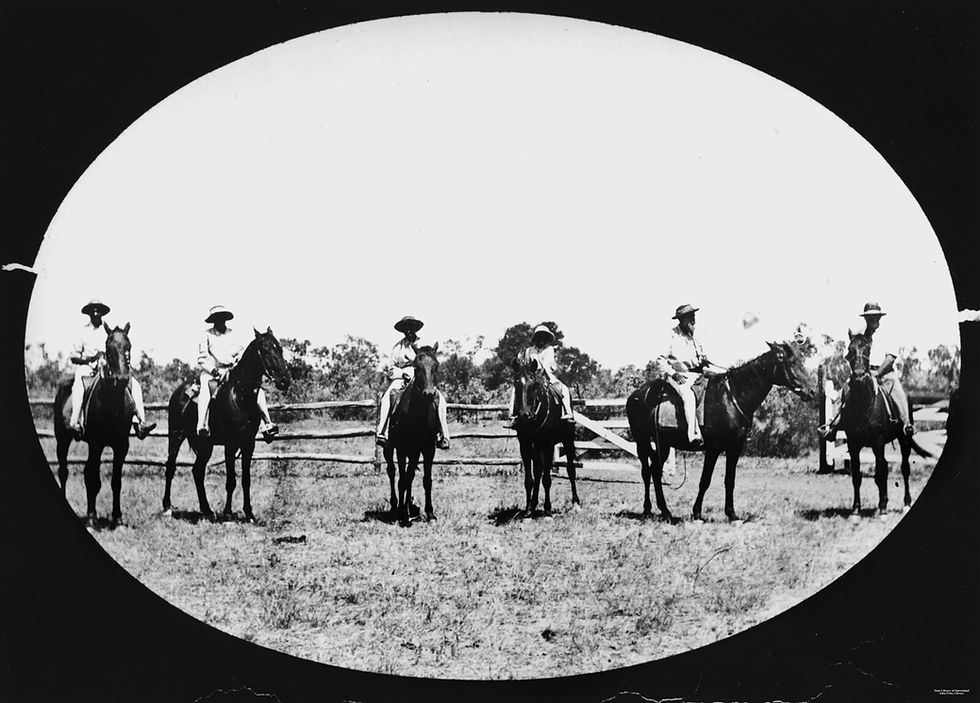
There was never one standard cattleman’s hat across Australia. Historical photographs show almost every variation imaginable: wide brims and narrow ones, tall crowns and low crowns, carefully formed hats and felt battered almost beyond recognition.
Some workers wore good felt hats. Others wore whatever they could afford and keep on their heads. Straw hats, cloth hats, and old felt hats all appear in station photographs. Climate, money, availability, and personal habit mattered more than any fixed dress code.
The modern Akubra Cattleman belongs to this tradition, but it is not a copy of one hat worn by every stockman in Australian history. It is a practical modern design that grew out of generations of outdoor work.
More Than the Lone Stockman
That work was carried out by a much wider range of people than the familiar image of a lone rider suggests.
Aboriginal stockmen were among Australia’s most skilled riders and cattle workers. They knew the country, the water, and the movement of animals. Their labor helped keep enormous pastoral stations operating, particularly across northern and inland Australia.
Women also rode, worked with cattle and horses, raised families, and kept station households running. Their contribution was often poorly recorded, if it was recorded at all.

Old station books occasionally preserve the names that larger histories missed. Records from Camboon Station in Queensland, for example, list Wulli Wulli people employed as stockmen, drovers, shepherds, general hands, and domestic workers.
A line in a ledger may be brief, but it proves that a person was there.
Many Aboriginal workers were paid less than white workers. Some received rations, clothing, or small allowances instead of regular wages. Their knowledge was valued when the cattle needed moving, yet they were often denied fair pay, decent housing, and control over their own lives.
Vincent Lingiari and the Wave Hill Walk-Off
One of those workers was Vincent Lingiari.
Lingiari grew up at Wave Hill Station in the Northern Territory and began station work at about twelve years old. He became a respected head stockman, helping manage a herd numbering in the tens of thousands.
In August 1966, he led Gurindji stockmen, domestic workers, and their families away from Wave Hill.
At first, the walk-off was a protest against poor pay and living conditions. It soon became something larger. The Gurindji were demanding the return of their land.
They stayed away.
The protest continued for years and became one of the defining moments in Australia’s land-rights movement. In 1975, Prime Minister Gough Whitlam handed part of the land back to the Gurindji people, pouring a handful of soil into Lingiari’s palm during the ceremony.
It remains one of the most powerful images in modern Australian history.
That story belongs beneath the brim of the Cattleman too.
The hat’s name can bring to mind horses, open country, and skilled riders moving cattle beneath a huge sky. Those things are part of the history. So are the workers whose names were forgotten, the wages that were never properly paid, and the Aboriginal families who fought to remain connected to their own Country.
The hat is only one part of the story. Behind it were people doing difficult work, raising families, and trying to make a life under conditions that were often unfair.
When a Working Hat Becomes Personal
A new Cattleman arrives neat and evenly formed. Its felt is clean. Its brim sits exactly as the maker intended.
Then someone begins wearing it.
The sun reaches it. The rain reaches it. Dust settles into it. The owner handles it, adjusts it, and reaches for it again the next morning.
That is when a working hat becomes personal.
The Cattleman was not named for one celebrated Australian. It was named for generations of people who worked with cattle across a difficult and beautiful country.
The hat remembers the occupation.
The history asks us to remember the workers.
Sources
Akubra, “Cattleman.” Official history, introduction date, measurements, materials, and construction details.
State Library of New South Wales, “Station Life.” Background on station work, stockmen, mustering, and droving.
Australian Institute of Aboriginal and Torres Strait Islander Studies, “Land and Pastoral Station Records.” Aboriginal stock workers, domestic workers, and the survival of station employment records.
State Library of Queensland, “Camboon Station Records.” Wulli Wulli people recorded as stockmen, drovers, shepherds, station hands, and domestic workers.
State Library of Queensland, “Aboriginal Stockwomen: The Hidden Figures of Australia’s Pastoral Industry.” The work of Aboriginal women in Australia’s cattle industry and the history of unequal wages and conditions.
National Museum of Australia, “Stockman’s Akubra Hat.” Aboriginal horsemen and women, droving work, and the role of horses and dogs in moving cattle.
Australian Dictionary of Biography, “Vincent Lingiari.” Lingiari’s childhood at Wave Hill, work as a head stockman, and leadership of the Gurindji walk-off.
National Archives of Australia, “The Wave Hill Walk-Off.” The 1966 walk-off, the campaign for land, and the 1975 transfer at Daguragu.