The Lawson: Finding a Way West

Under the Australian Brim, Part Three
The Lawson arrived in a deeper brown than I expected.
I had looked at photographs before ordering it, but photographs only tell you so much. In person, the felt is rich and warm. I wasn’t sure about the color at first, but once I put the hat on, I liked it.
I kept wearing it for the rest of the day.
Like my other Akubras, it was comfortable almost immediately. The Lawson does feel different, though. The Banjo Paterson seems to work with nearly anything I happen to be wearing. The Lawson makes me think more carefully about the shirt beneath it. It feels as though I should dress properly for the hat.
A few hours after it arrived, I opened the door to sign for another package. The FedEx driver looked at the Lawson and told me he loved it.
The hat had been in my house for only part of a day, and it had already started a conversation.

The Name Inside the Hat
What I had not understood yet was the name inside it.
I first thought the hat had been named for Henry Lawson, the Australian writer. That seemed believable, especially because Akubra also makes the Banjo Paterson. I began reading Henry Lawson and became deeply interested in his work.
Then an older Akubra record sent the story in another direction.
The National Library of Australia has preserved earlier versions of Akubra’s website. The Lawson is not shown on the archived site from 4 September 2004. There are no saved snapshots from 2005. By 20 August 2006, however, the hat appears on Akubra’s Heritage Collection page in Heritage Fawn and Loden, with a plaited ridgeback leather band.
The description is direct:
Named after the famous Australian explorer William Lawson.

The other hats on the page help explain the choice. The collection included hats named for Matthew Flinders and the explorers Burke and Wills. Banjo Paterson was the one literary figure in the group.
The archived pages do not give us an exact release date. They tell us only that the Lawson was absent from Akubra’s online range in September 2004 and was there by August 2006.
But they settle the more important question. The hat was named for William Lawson, the explorer.
Finding the Way West
Lawson is best remembered for his part in the 1813 expedition that established a workable colonial route through the Blue Mountains west of Sydney.
The name “Blue Mountains” can make them sound like a simple row of peaks. They are not. The country is made up of sandstone ridges, cliffs, deep valleys, and gorges. A route that looked promising could end above a sudden drop or lead into country too steep for loaded horses.
Earlier European parties often followed rivers and valleys, hoping the waterways would guide them through. Instead, they found themselves hemmed in by cliffs and rough ground.
By 1813, the British settlement around Sydney wanted more grazing land. Sheep and cattle numbers were growing, while drought and hard use had placed pressure on farms east of the mountains. Pastoralists hoped that better country lay somewhere beyond them.
Gregory Blaxland believed the answer was to stay high and follow the ridges rather than the valleys.
On 11 May 1813, Blaxland set out with William Charles Wentworth and William Lawson. Four other men traveled with them, along with four loaded horses and several dogs.
Lawson brought surveying experience.
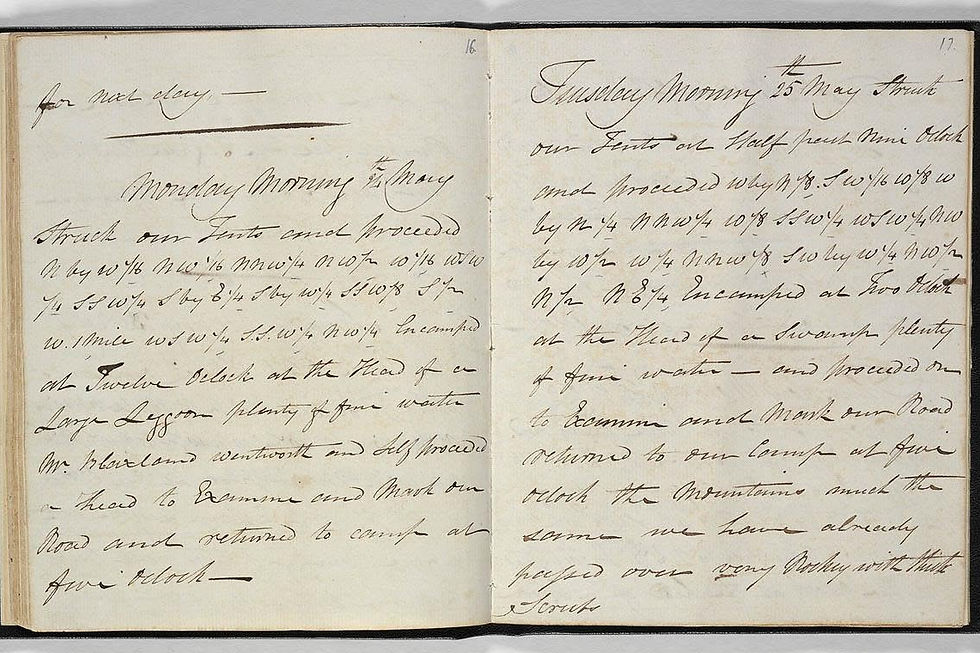
His journal shows what that meant in practice. He wrote down directions, distances, water sources, and the condition of the country. His notes were not written to entertain anyone. They were meant to be useful.
The work itself was slow.
Men went ahead on foot to inspect the ridge and mark trees. Thick scrub had to be cut before the horses could move forward. Sometimes a possible route ended at a cliff or deep gully, and they had to turn around and try again.
They often covered the same ground more than once, first to find a way through, then to clear it, and then again to bring the horses and supplies forward.
Fog and damp weather made it harder to see the shape of the land. Water had to be found for both the men and the animals. The horses needed feed. Each day carried the party farther from the settled country behind them.
By the end of May, Lawson wrote that their shoes were worn out and their provisions nearly finished.
Then the country began to open.
From high ground later known as Mount Blaxland, the party looked toward forest and grassland that appeared suitable for livestock. They had not explored the whole western interior, and they had not built a road. What they had done was show that a useful route could be found by staying on the ridges.
A Record Others Could Follow
Lawson’s journal helped others follow it.
Later in 1813, surveyor George William Evans followed their track and continued farther west. In 1814 and 1815, William Cox and a convict road gang built a road across the mountains. Governor Lachlan Macquarie traveled over it and established Bathurst. Lawson later served there as commandant.
That is why his part in the expedition mattered.
He did not lead the party, and he did not do the work alone. The other men who cut through the scrub, watched the supplies, and handled the horses were essential.
Lawson’s particular contribution was to measure what they had done and leave a record of it.
A Route Through Aboriginal Country
The mountains were not unknown country before 1813. Aboriginal people had lived in and traveled through them for countless generations. The Blue Mountains and the land farther west were Country for Dharug, Gundungurra, Wiradjuri, and other Aboriginal peoples.
Blaxland, Wentworth, and Lawson did not discover an empty land. They established a route that British settlers could use.
The road that followed brought sheep, cattle, fences, and land grants into Aboriginal Country. Around Bathurst, that expansion led to dispossession and violent conflict with the Wiradjuri.
Both parts of the story matter. The expedition was a difficult achievement in navigation and endurance. It also helped open the way for colonial expansion and everything that followed.
The Hat and the History
The Lawson hat is not a copy of anything William Lawson is known to have worn. There is no reason to pretend that it is. Akubra made a modern Australian hat and gave it the name of an explorer.
Still, now that I know the story, the name feels different.
The rich brown felt is restrained rather than showy. The braided leather band gives the hat character without taking it over. It looks comfortable outdoors, but it does not seem out of place in town.
I bought the Lawson thinking it was connected to a writer.
An old Akubra webpage sent me somewhere else: to a narrow ridge, four packhorses, worn shoes, and a surveyor writing down the way west.
The hat arrived first.
The history took a little longer.
On that same old Heritage Collection page, the Lawson appears beside Flinders and Burke and Wills, other names Akubra chose to remember under the Australian brim.
Sources
Akubra Heritage Collection page, archived 20 August 2006 by the National Library of Australia. Primary Akubra source identifying explorer William Lawson as the hat’s namesake and showing the Lawson in Heritage Fawn and Loden with a plaited ridgeback leather band.
Akubra website, archived 4 September 2004 by the National Library of Australia. Used to establish that the Lawson was not shown in the archived online range at that date.
William Lawson, “Journal of an Expedition Across the Blue Mountains, 11 May–6 June 1813,” State Library of New South Wales. Primary account of the expedition’s route, terrain, supplies, horses, and daily progress.
State Library of New South Wales, “Finding the Way West.” Used for the expedition’s methods, the ridge route, and Lawson’s role as surveyor and record-keeper.
Australian Dictionary of Biography, C. J. King, “William Lawson.” Used for Lawson’s background, surveying experience, later career, and service at Bathurst.
National Museum of Australia, “Blue Mountains Crossing.” Used for the pressure to find grazing land, Aboriginal knowledge of the mountains, and the effects of colonial expansion westward.
UNESCO World Heritage Centre, “Greater Blue Mountains Area.” Used for the physical character of the Blue Mountains landscape.